CODING COMPARISON · OCTOBER 5, 2026
GPT-6.1 Sol vs Opus 5.5, in four panels
In one reported Go interpreter test, Sol’s code ran faster on a small calculation. Opus’s code handled infinite recursion without crashing the process. The finish line was only part of the test.
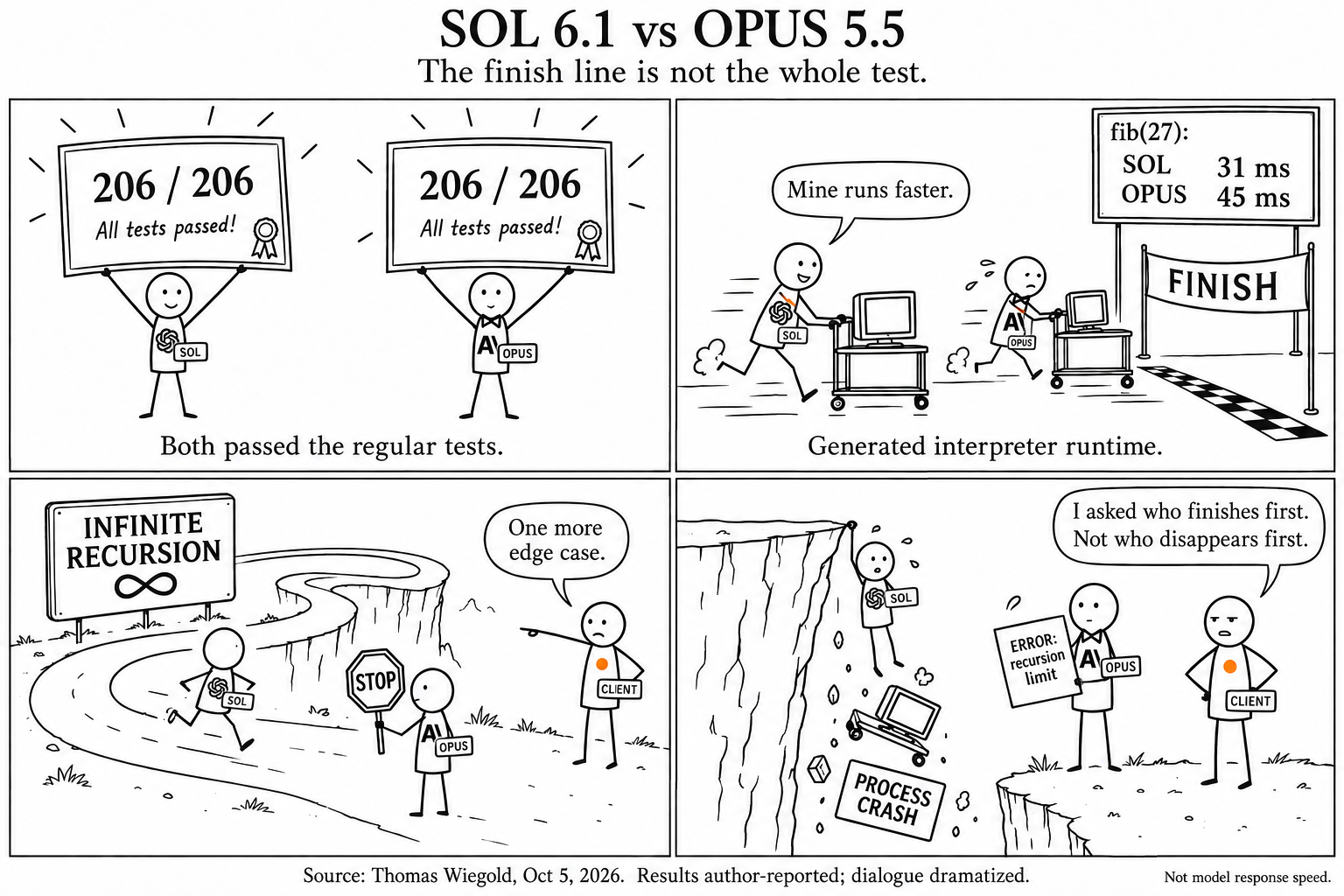
Author-reported results, not a test performed by OpenDots. Company marks identify the characters; this is an independent editorial comparison.
The results behind the joke
| Check | GPT-6.1 Sol | Opus 5.5 |
|---|---|---|
| Handwritten conformance cases | 206 / 206 passed | 206 / 206 passed |
| fib(27) execution time | 31 ms | 45 ms |
| Unbounded recursion | Process crashed | Error returned |
These timings describe the generated programs, not how quickly the models answered. The reviewer also reports that Opus’s depth limit rejected some extremely deep, valid programs. This is one task, not a universal ranking.
What to check in your own code
Use known answers and failure cases alongside the happy path. Check whether generated code stops safely when inputs exceed its limits, and whether those limits reject work you actually need.
Comic transcript
- Both coworkers hold certificates: “206 / 206. All tests passed!”
- Sol says, “Mine runs faster.” The fib(27) scoreboard shows Sol 31 ms and Opus 45 ms. These are generated interpreter runtimes.
- The client says, “One more edge case.” The sign reads “Infinite recursion”; Opus holds a stop sign.
- Sol’s generated interpreter crashes. Opus returns a recursion-limit error. The client says, “I asked who finishes first. Not who disappears first.”
Source and illustration
Based on Thomas Wiegold’s GPT-6.1 Sol review, published October 5, 2026. We have not reproduced the benchmark. The race, cliff, characters and dialogue are editorial inventions.
AI-generated illustration using the Orange Line Illustration skill. OpenAI and Anthropic marks identify the models’ companies. OpenDots is not affiliated with either company.